visibility
Dark Brown Eyes
straighten
High Tail Carriage
texture
Coarse Penciling
rectangle
Rectangular Silhouette
Groninger Meeuw Kriel

The Groninger Gull Bantam is a rare and vital Dutch breed from the northern Netherlands, prized for its unique 'drop-shaped' penciling and high tail carriage. Often confused with the East Frisian Gull, it is distinguished by its much darker eyes and robust, rectangular build.
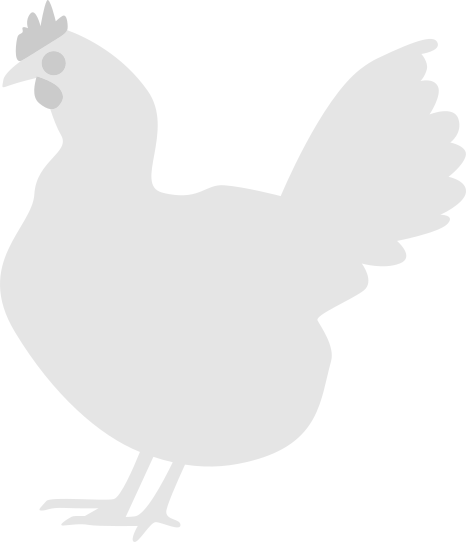
The Groninger Gull Bantam is a light, elegantly built breed with a rectangular body shape. A defining feature is its high tail carriage, carried at a blunt angle with the back. Unlike its cousin, the East Frisian Gull, the Groninger must have dark brown to black-brown eyes. They feature a single comb, white earlobes, and slate-blue legs. Roosters weigh approximately 28 oz (800g) and hens 25 oz (700g). Their plumage is tight, emphasizing their agile and alert silhouette.
Despite being primarily kept for exhibition today, the Groninger Gull remains a prolific layer for a bantam. Hens can produce about 150 to 170 eggs per year. The eggs are pure white and weigh around 1.2 oz (35g). Hens are generally not broody, reflecting their high-energy, flighty landrace origins. They are early to mature, and the chicks are notably vital and fast-growing under good conditions.
Sexual dimorphism in the Groninger Gull is striking. Roosters appear largely solid-colored (silver or gold) on the upper body, but they feature deep black drop-shaped spots on the feathers beneath the hackle and on the wing coverts. Their tail is deep black with green sheen and a thin lacing of the primary color on the sickles. Hens display the characteristic 'pelling' (penciling) over most of the body except the neck and upper breast. This penciling is coarser and more blocky (dopvormig) than the fine penciling found on Frisian Bantams.
The Groninger Gull is very hardy and well-adapted to the windy, damp coastal climates of Northern Europe. They are active foragers and thrive in a free-range setting. They are known for being excellent flyers and often prefer to roost high up if given the chance. In an American backyard setting, a covered run or high fencing is essential. They are resistant to common winter ailments but require a dry coop to maintain their tight feathering.
The two primary and most popular color varieties are Gold Penciled (Goudpel) and Silver Penciled (Zilverpel). A Citron Penciled (Citroenpel) variety has also been developed and recognized in recent years. The gold variety features a warm reddish-gold base, while the silver is a crisp, bright white. In both, the contrast with the deep black 'drop' spots and blocky penciling is what judges look for in exhibition specimens.
The Groninger Gull shares an ancient lineage with various 'penciled' coastal breeds of the North Sea. It was once widely distributed across the Dutch-German border. However, the Groninger variant was officially distinguished from the East Frisian version around 160 years ago, primarily based on its dark eye color. The breed faced near-extinction at the end of the 1970s but experienced a remarkable rebirth due to a renewed interest in traditional Dutch breeds. It remains a rare cultural heritage breed (cultuurgoed) that American enthusiasts value for its history and vitality.
Horst Schmidt (1996). Rashoenders.
Rüdiger Wandelt & Josef Wolters (1995). Handboek Rashoenders.
Verhoef, E., Rijs, A. (2001). Geïllustreerde Hoender Encyclopedie. Rebo Productions.
Esther Verhoef, Aad Rijs (2005). Geillustreerde Kippen Encyclopedie. Rebo International.
Kleindierliefhebbers Nederland (2024). Standaard voor Hoenders en Dwerghoenders (Groninger Meeuw).
Groninger Meeuwenclub. https://www.groningermeeuwenclub.nl/.
Stichting Zeldzame Huisdierrassen (SZH). SZH - Rassen hoenders. https://szh.nl/rassen/hoenders/.